CRM vs ERP
CRM vs ERP: the difference, in one line

Why the question comes up
"CRM or ERP?" is usually the wrong question. "Which one first?" is the right one.
- The two categories overlap at the edges — both touch customers, both hold data, both promise to be your "single system" — so the marketing makes them sound interchangeable. They aren't.
- An ERP is a serious commitment: it reaches into finance, stock, and payroll, and it's rarely the first software a small team buys. A CRM earns its place the day you have more deals than you can track in a spreadsheet.
- Customers come before back-office automation. Most small teams feel the CRM gap first — leads going cold, no shared pipeline — and reach ERP territory later, if at all.
What each one is actually for
Two tools, two halves of the business. Here's the honest split.
CRM — the customer-facing half
A CRM is where customer relationships live.
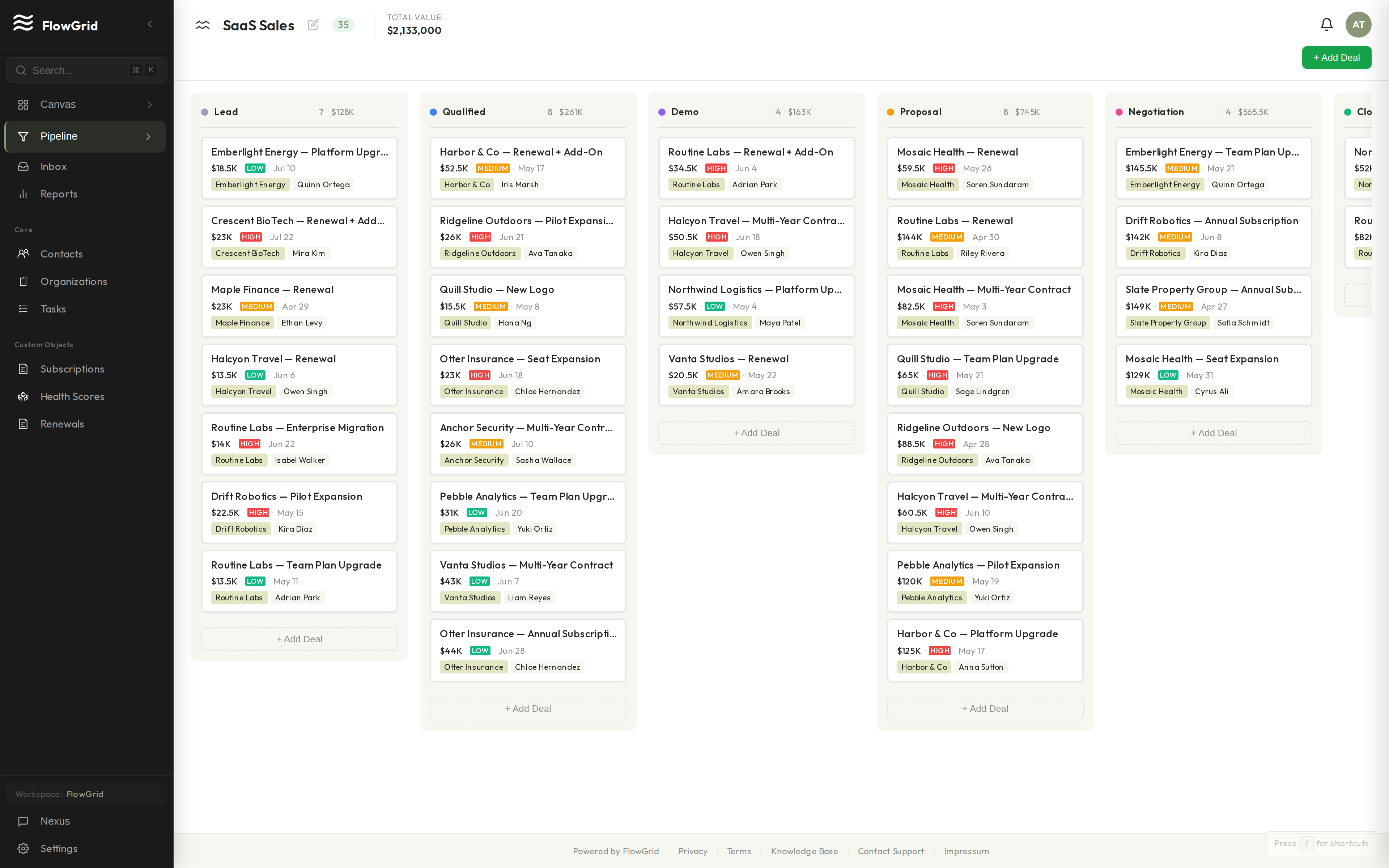
Contacts and organizations, deals moving through a pipeline, the notes and calls and emails attached to each one. A CRM answers questions like "which deals close this month?" and "when did we last talk to this account?" It is the system of record for everyone outside your company.
FlowGrid is a CRM. You get contacts, organizations, deals, pipelines, tasks, and email integration — plus a canvas you shape by describing what you want to Nexus, FlowGrid's AI assistant. Type a prompt, get a dashboard. No template gallery to pick from.
ERP — the internal-operations half
An ERP is where your back office runs.
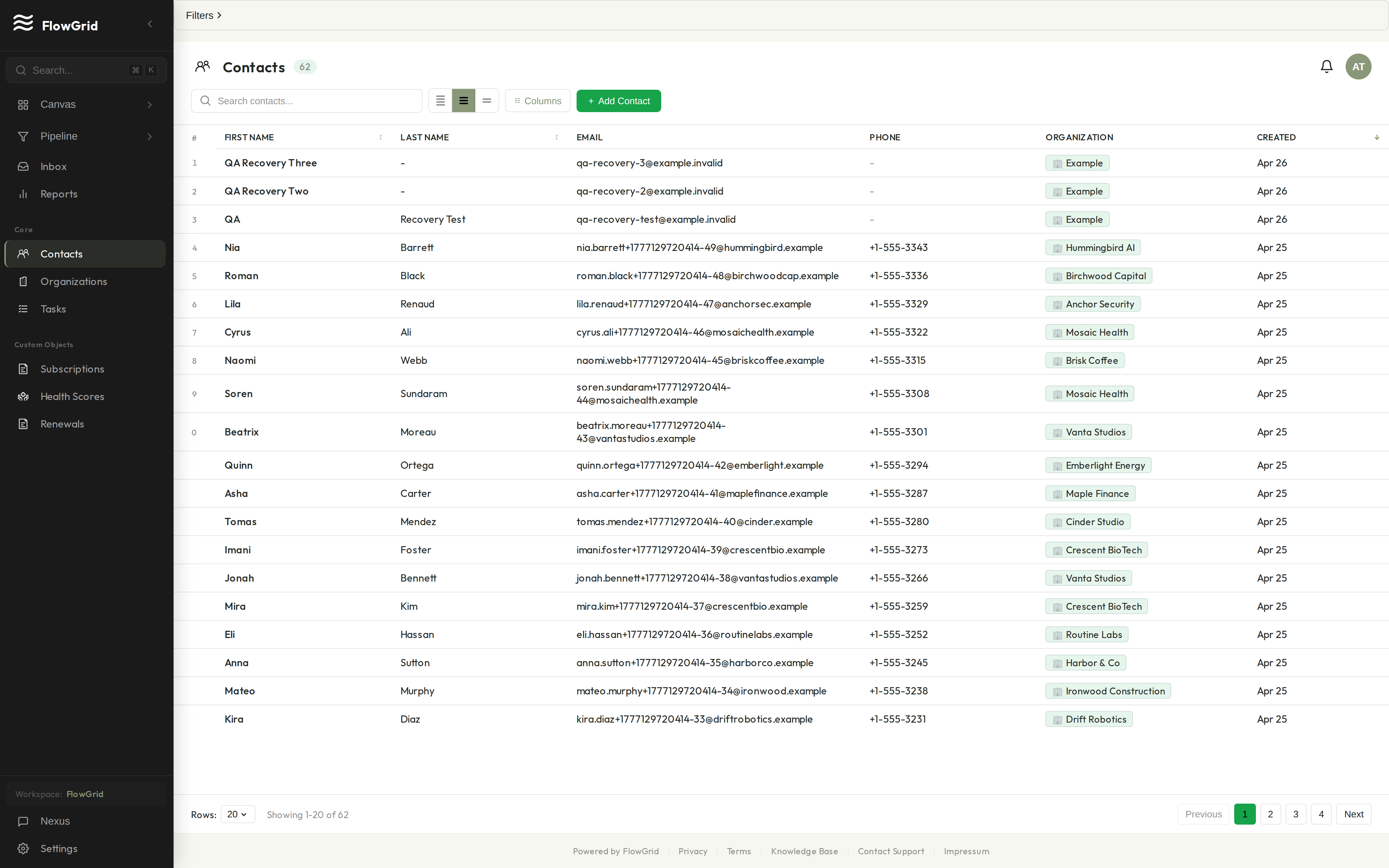
Accounting and the general ledger, inventory and warehousing, purchasing, HR and payroll, and — for the businesses that make physical things — manufacturing and supply-chain planning. An ERP ties those internal functions together so a sale flows through to stock and the books without re-keying.
If your business is built on physical inventory, manufacturing runs, or finance that's outgrown accounting software, that is genuine ERP work. An ERP is the right tool for it. A CRM is not, and a good CRM won't pretend otherwise.
Where they meet — and where most teams land
Many businesses run both. The order tends to be CRM first.
The categories overlap on customer data — an order placed in the ERP and a deal won in the CRM describe the same event. Larger companies connect the two so that overlap stays in sync. That's normal, and it's why "CRM vs ERP" is rarely a real either/or for a growing business.
But sequencing matters. A small team usually feels the customer-tracking gap long before it needs back-office automation, so the CRM is the first system it buys. The ERP, if it ever arrives, comes later — alongside the CRM, not instead of it.
Side by side
CRM vs ERP, in plain language.
| Aspect | CRM | ERP |
|---|---|---|
| What it manages | Customer-facing work: contacts, organizations, deals, pipeline, communication. | Internal operations: accounting, inventory, purchasing, HR, manufacturing. |
| Who lives in it daily | Sales, account management, founders tracking revenue and relationships. | Finance, operations, warehouse, HR — the people running the business behind the sale. |
| The question it answers | "Which deals close this month, and when did we last talk to this account?" | "What's our stock level, what do we owe, and is payroll covered?" |
| When a team adopts it | Early — the day deals outgrow a spreadsheet and leads start slipping. | Later — once finance, inventory, or manufacturing outgrows separate tools. |
| Where FlowGrid fits | FlowGrid is a CRM. Built for small teams that need the customer-facing half first. | FlowGrid is not an ERP. No accounting, inventory, manufacturing, or HR — by design. |
- Customer-facing work: contacts, organizations, deals, pipeline, communication.
- Internal operations: accounting, inventory, purchasing, HR, manufacturing.
- Sales, account management, founders tracking revenue and relationships.
- Finance, operations, warehouse, HR — the people running the business behind the sale.
- "Which deals close this month, and when did we last talk to this account?"
- "What's our stock level, what do we owe, and is payroll covered?"
- Early — the day deals outgrow a spreadsheet and leads start slipping.
- Later — once finance, inventory, or manufacturing outgrows separate tools.
- FlowGrid is a CRM. Built for small teams that need the customer-facing half first.
- FlowGrid is not an ERP. No accounting, inventory, manufacturing, or HR — by design.
The honest part
FlowGrid is a CRM, not an ERP — and isn't trying to be one.
We should be plain about this: FlowGrid does not do accounting, inventory, manufacturing, or HR, and it has no plans to. If your business needs ERP functions, you need an ERP — possibly an ERP running alongside a CRM, not a CRM stretched to cover work it was never built for. What FlowGrid does well is the customer-relationship half: contacts, deals, pipelines, and an AI canvas you shape by talking to it. If a CRM is the system you need first, that's the part we built.
Verifiable, not assumed
We're early. Here's how you can verify us anyway.
How your data is protected
Field-level AES-256-GCM encryption with tenant-scoped keys. Multi-tenant row-level isolation. Every mutation logged.
Read the security details →Legal & compliance
GDPR-compliant with a Data Processing Addendum. Your legal contact can pull it now — not after a sales call.
Read the DPA →Built in public
v1.3.0 · Jun 20, 2026
v1.3.0
v1.2.0 · Jun 10, 2026
v1.2.0
v1.1.0 · Jun 2, 2026
v1.1.0
Built in public
We don't have customer logos to show you yet.
FlowGrid is early. Instead of borrowed credibility, here's what you can verify yourself:
Honest answers