For teams leaving cobra CRM
From a desktop-era German CRM to one you shape by talking to it.

What we hear from teams on cobra
A desktop-heritage CRM is a lot of weight to carry into 2026.
- cobra is one of the longest-established German CRMs, with roots going back to the address-management era — and it does traditional CRM well. But it grew up as desktop and on-premise software, and that heritage shows: something to install, something to keep current, a tool that sits on the machine rather than in the browser.
- Reshaping cobra around how your team actually works tends to mean an implementation partner and a configuration project. That's the established-vendor way, and it works — it's just slow and external when you'd rather change the CRM yourself, this afternoon.
- It's a capable CRM, but not an AI-native one. There's no assistant you can simply talk to — describe the view you want, the object you need, the report you'd like — and watch the workspace take that shape.
How FlowGrid is different
Same privacy seriousness. None of the desktop-era weight.
Canvas, not a desktop layout
Describe the workspace you want. It takes that shape.
cobra hands you an established desktop CRM and, often, a partner to configure it. FlowGrid hands you a canvas. You shape it by talking to Nexus — ask for a pipeline view, a follow-up board, a contacts dashboard — and the canvas rearranges around how your team actually works.
Nothing to install. No rigid templates. No configuration project booked weeks out — just a workspace that adjusts to you, in the browser, the moment you ask.
Custom objects, shaped by prompt
Model the records your work runs on — by asking, not by a project.
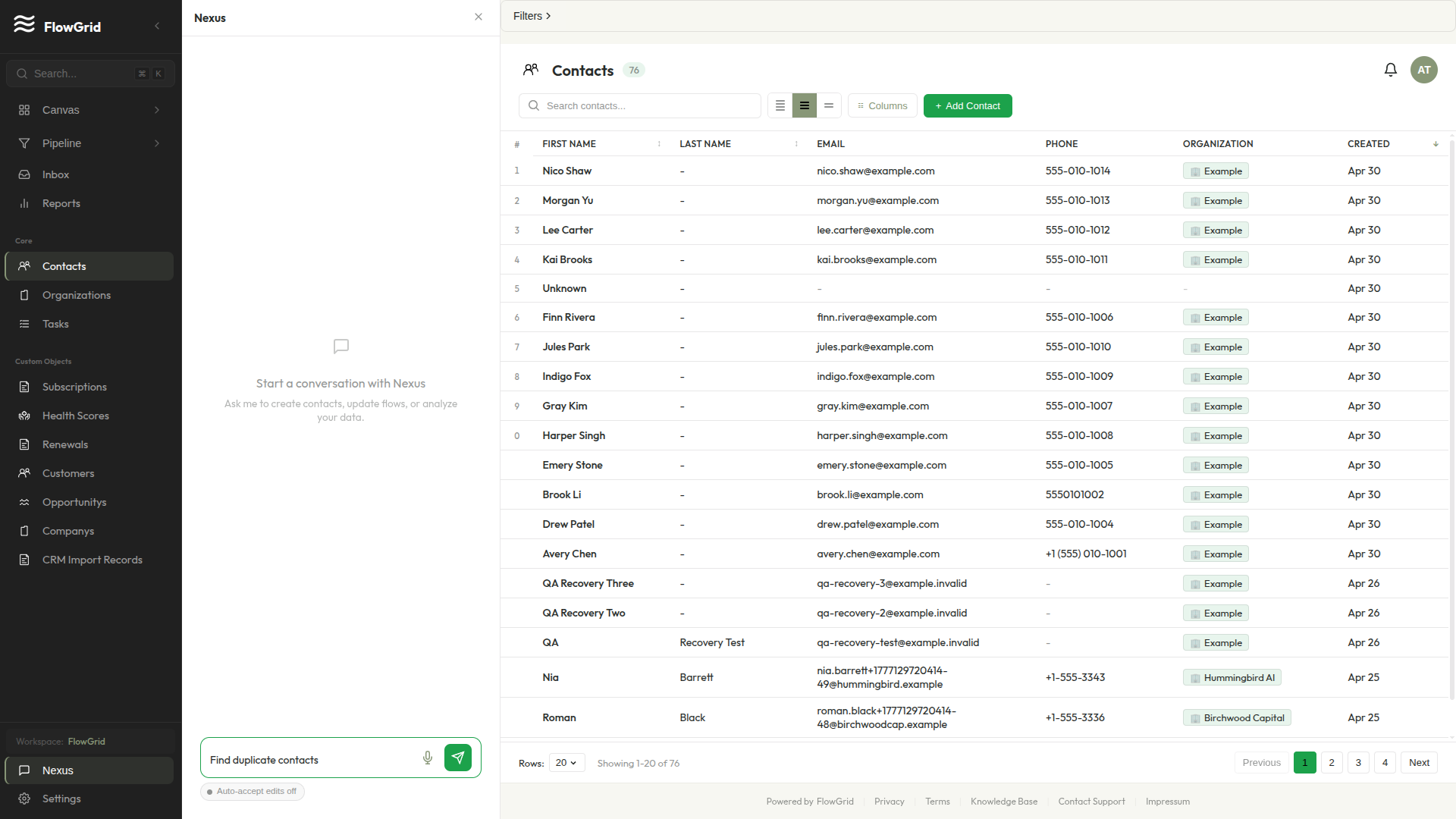
A CRM has to hold whatever your team tracks — projects, renewals, partners, assets. FlowGrid gives you custom objects, fields, and relationships from day one. Ask Nexus "add a Renewals object linked to Organizations" and confirm before it ships — no partner-led setup in between.
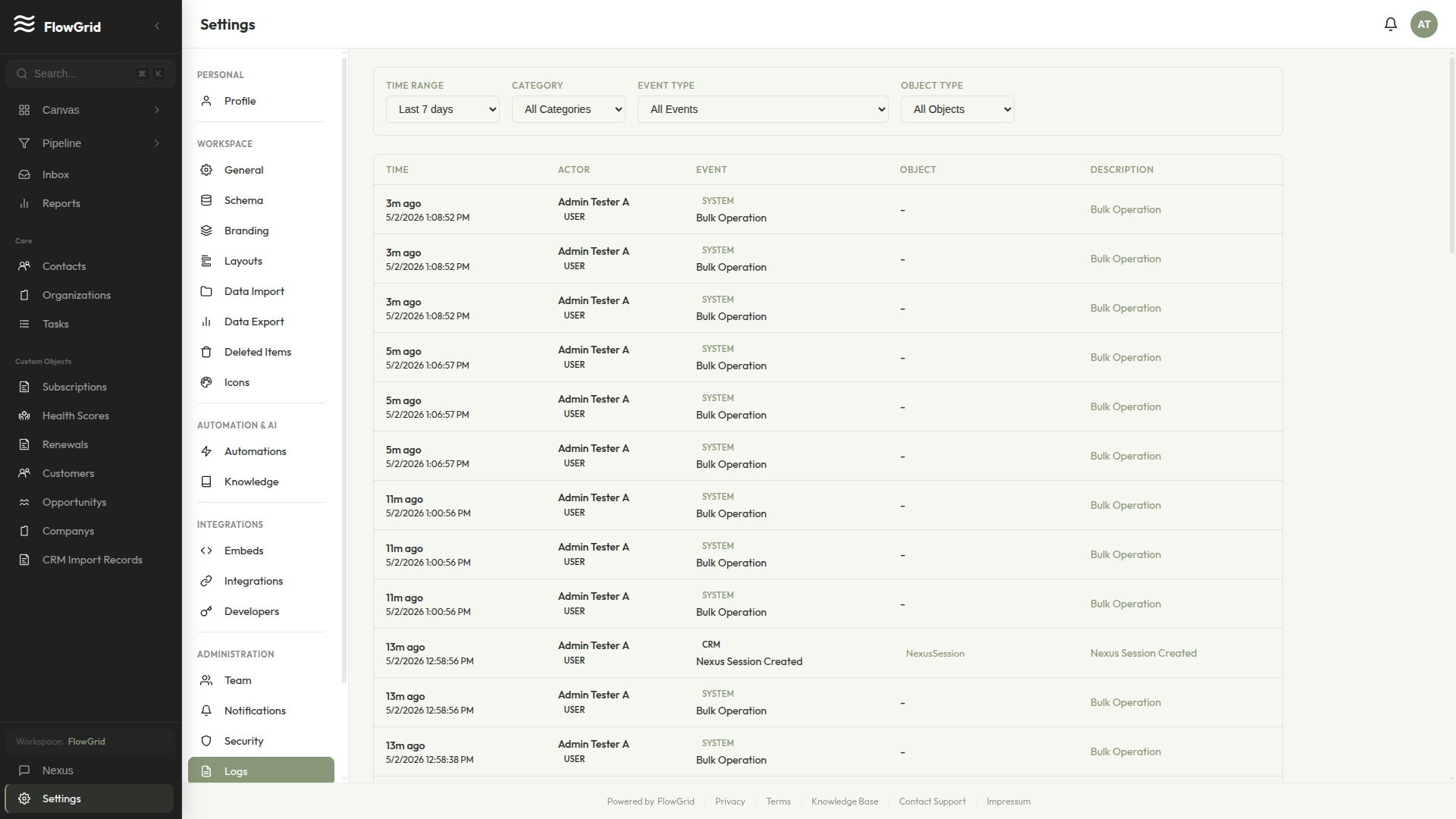
Nexus has 60+ tools bound to your schema, so it works with the objects you create. Every action is confirmed before it runs and logged in your audit trail — you stay in control, and the change happens while you're still in the conversation.
Privacy as the default
Field-level encryption with keys only your tenant holds.
German-market buyers ask hard questions about data, and they should. AES-256-GCM encryption at the field level. Tenant-scoped keys. Multi-tenant isolation enforced with row-level security at the Postgres layer, so one workspace reading another's records isn't a setting — it's a database-level impossibility.
GDPR-compliant with a DPA your legal contact can pull today, and customer CRM records are stored in the Zurich region of Switzerland — a jurisdiction with an EU adequacy decision. Full security details are public, with the gaps named honestly.
Side-by-side, no strawman
FlowGrid vs cobra CRM, in plain language.
| Aspect | cobra CRM | FlowGrid |
|---|---|---|
| Who it's built for | The German Mittelstand. A decades-established CRM with deep roots in contact and address management — trusted, traditional, and well understood by the teams that run it. | Small teams that want a modern, general-purpose CRM — a flexible workspace for pipeline, contacts, and custom records, without the weight of desktop-era software. |
| Shaping the CRM | Configured to fit your team, typically with an implementation partner. Capable and proven — it's just a setup project rather than something you change yourself. | A canvas you shape by talking to Nexus. Ask for the views you need; the workspace rearranges. No partner, no project — just a prompt. |
| AI assistant | A traditional CRM. AI capability depends on your edition and setup; it's not built around an assistant you talk to. | Nexus, an AI assistant with 60+ tools bound to your schema — including the custom objects you create. Included in every seat. |
| Custom records | Strong, configurable contact and CRM data, in the tradition of an established vendor — adjusted to fit during implementation. | Custom objects, fields, and relationships from day one. Model projects, renewals, partners — whatever your team runs on, shaped by prompt. |
| Data privacy | A German vendor with the privacy posture you'd expect from a long-established product; specifics depend on your edition and deployment. | Field-level AES-256-GCM encryption with tenant-scoped keys, row-level isolation, and a published DPA. CRM records stored in the Zurich region of Switzerland. |
| Your data on the way out | Export availability and format depend on your edition and deployment. | CSV export of every record and every field, on every plan. Tenant-scoped keys mean nobody else can read what you leave behind. |
- The German Mittelstand. A decades-established CRM with deep roots in contact and address management — trusted, traditional, and well understood by the teams that run it.
- Small teams that want a modern, general-purpose CRM — a flexible workspace for pipeline, contacts, and custom records, without the weight of desktop-era software.
- Configured to fit your team, typically with an implementation partner. Capable and proven — it's just a setup project rather than something you change yourself.
- A canvas you shape by talking to Nexus. Ask for the views you need; the workspace rearranges. No partner, no project — just a prompt.
- A traditional CRM. AI capability depends on your edition and setup; it's not built around an assistant you talk to.
- Nexus, an AI assistant with 60+ tools bound to your schema — including the custom objects you create. Included in every seat.
- Strong, configurable contact and CRM data, in the tradition of an established vendor — adjusted to fit during implementation.
- Custom objects, fields, and relationships from day one. Model projects, renewals, partners — whatever your team runs on, shaped by prompt.
- A German vendor with the privacy posture you'd expect from a long-established product; specifics depend on your edition and deployment.
- Field-level AES-256-GCM encryption with tenant-scoped keys, row-level isolation, and a published DPA. CRM records stored in the Zurich region of Switzerland.
- Export availability and format depend on your edition and deployment.
- CSV export of every record and every field, on every plan. Tenant-scoped keys mean nobody else can read what you leave behind.
Verifiable, not assumed
We're early. Here's how you can verify us anyway.
How your data is protected
Field-level AES-256-GCM encryption with tenant-scoped keys. Multi-tenant row-level isolation. Every mutation logged.
Read the security details →Legal & compliance
GDPR-compliant with a Data Processing Addendum. Your legal contact can pull it now — not after a sales call.
Read the DPA →Built in public
v1.3.0 · Jun 20, 2026
v1.3.0
v1.2.0 · Jun 10, 2026
v1.2.0
v1.1.0 · Jun 2, 2026
v1.1.0
Built in public
We don't have customer logos to show you yet.
FlowGrid is early. Instead of borrowed credibility, here's what you can verify yourself:
Honest answers