Outgrew Notion?
What you graduate to when Notion breaks.
Where Notion-as-CRM cracks
Notion is a great wiki. It's a database pretending to be a pipeline.
- You hit the record cap. Or the page-size cap. Or the relations-on-relations cap. The workspace gets slow exactly when the team grows.
- A template tweak broke half your workflows. Bidirectional relations drift. Formula properties that referenced a renamed column silently return blank.
- Your audit story is per-page edit history, scoped to a single page. Your DPO asks who changed which contact when — there's no workspace-wide answer.
What FlowGrid gives you
A real schema, the flex you came for, and an AI that knows the difference.
Custom objects with real types
Define the schema you actually need. Or talk Nexus into building it.
Contacts, companies, deals — and any custom object you need: projects, properties, retainers, candidates. Each with proper types (text, number, date, currency, single-select, link to another object) instead of text-with-conventions.
Add a field by prompting Nexus. Existing records get it. Schema changes are tracked, reversible, and confirmed before they ship.
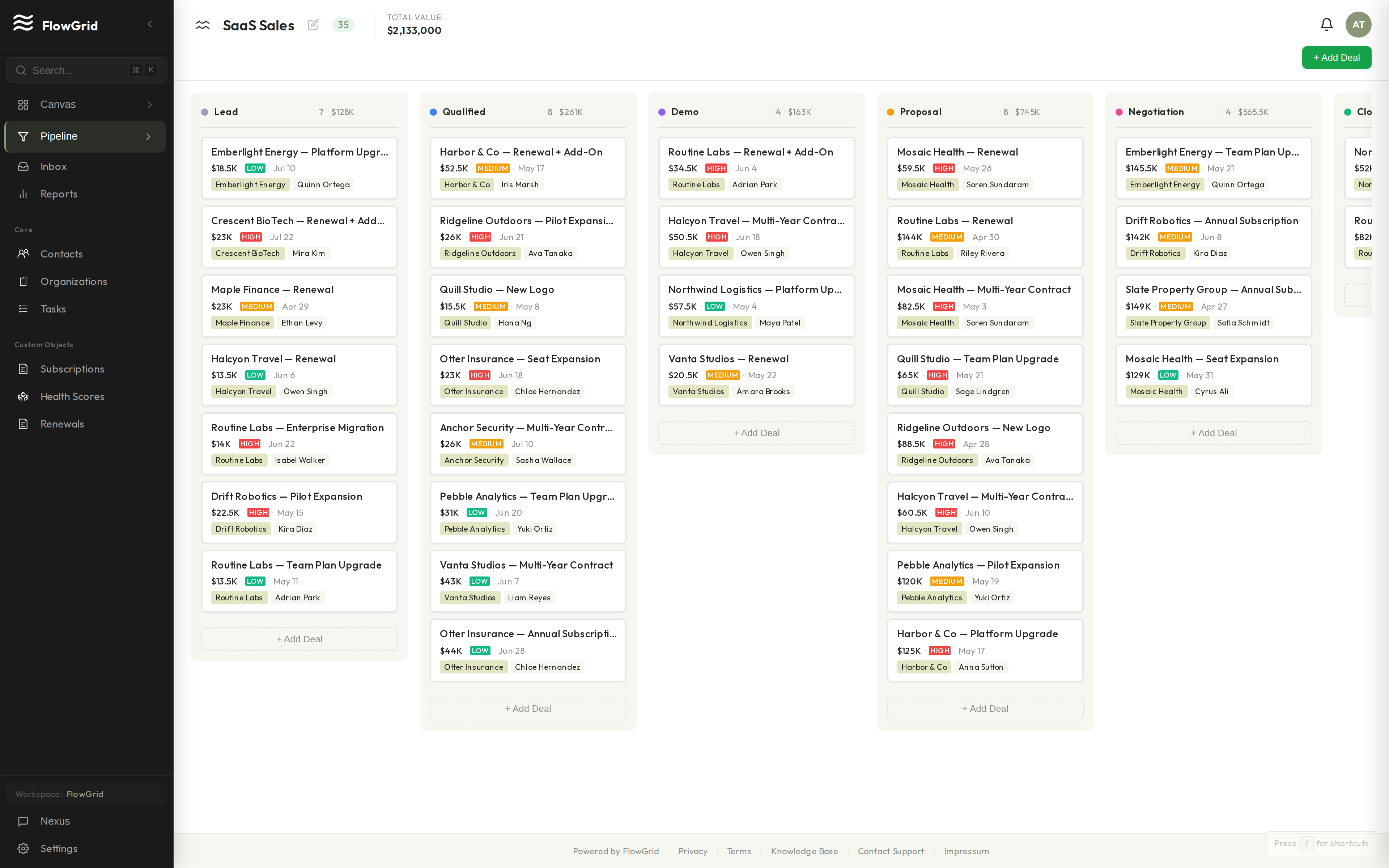
A real pipeline
Custom stages, real deal cards, stage-change history.
Not a database with a Status property. A pipeline that knows about win rates, time-in-stage, and the difference between “Negotiation” and “Closed Won”. Drag a card; the audit log records who moved what when.
Multiple pipelines per workspace. Pipeline-specific stages. Per-deal custom fields. The shape of your sales process, not a template.
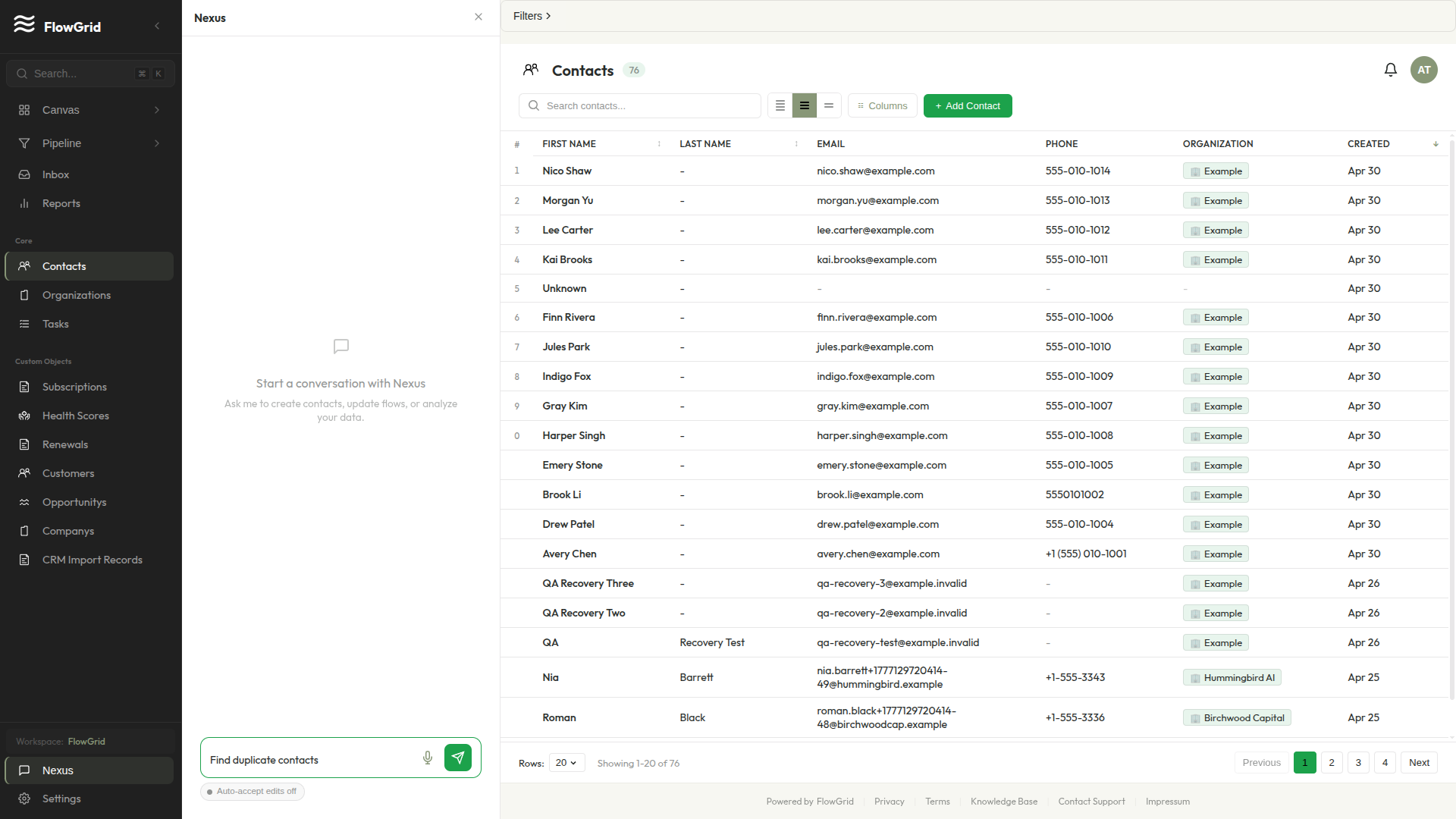
AI that respects the schema
Nexus has 60+ tools wired into your objects.
Ask “show me deals closing this month grouped by owner” — you get a real widget, bound to your pipeline. Ask Nexus to add a custom field; it’s confirmed before it ships and recorded in your audit log.
Sandboxed to your workspace. It can’t see other tenants. Every action is logged. Field-level encryption with tenant-scoped keys means even FlowGrid support can’t read your records without your explicit grant.
Side-by-side, where it matters
FlowGrid vs Notion-as-CRM, on the points that broke for you.
| Aspect | Notion as CRM | FlowGrid |
|---|---|---|
| Pipelines | Database with a Status property. Looks like a pipeline; isn't one. No win rates, no stage durations, no audit on stage changes. | First-class pipelines with custom stages, deal cards, and stage-change history. Win rate and time-in-stage out of the box. |
| Relationships between objects | Relation properties that drift. Bidirectional sync that breaks under template duplication. No referential integrity. | Real relationships defined at the schema layer. Cascades on delete, foreign keys enforced at the database, calculated rollups. |
| Custom objects | Every object is a database. Lose properties when duplicating templates. No type system; everything is text-with-conventions. | Custom objects with proper types (text, number, date, currency, single-select, link). Add via Nexus prompt; existing records get the new field. |
| Calculated & rollup fields | Formula property that breaks if you rename a column. No cross-database aggregations beyond simple rollups. | Calculated fields that survive schema renames. Rollups across related objects (e.g. company.deal_count, contact.lifetime_value). |
| Audit log | Per-page edit history, scoped to a page. No workspace-wide trail of who changed what record when. | Append-only audit log on every record. Actor, before/after, timestamp. Exportable for DPO requests. |
| Hitting the wall | Block limits, slow loads on databases past a few thousand rows, sluggish filtering, template hacks that fall over. | Built for the workload. Real database under the hood, indexed for the queries a CRM actually runs. |
| Privacy | Workspace-level access. Notion staff can read your pages while supporting issues. AI features train on workspace content unless explicitly disabled. | Field-level encryption with tenant-scoped keys. Support cannot decrypt your records without explicit grant. Nexus runs sandboxed to your workspace. |
Verifiable, not assumed
We’re early. Here’s how you can verify us anyway.
How your data is protected
Field-level AES-256-GCM encryption with tenant-scoped keys. Multi-tenant row-level isolation. Every mutation logged.
Read the security details →Legal & compliance
GDPR-compliant with a Data Processing Addendum. Your legal contact can pull it now — not after a sales call.
Read the DPA →Built in public
Built in public
We don’t have customer logos to show you yet.
FlowGrid is early. Instead of borrowed credibility, here’s what you can verify yourself:
Honest answers